
Wadi Rum Climbing Guide
Updated 27 October 2026 · Eid Salman, Bedouin guide and climber, and Amina
Climbing in Wadi Rum at a glance
| Topic | In short |
|---|---|
| The rock | Red sandstone, soft and sometimes sandy. Wear a helmet everywhere, at the foot of the routes as well as on the wall. |
| The style | Mostly traditional climbing with gear you place yourself. A few bolted routes, including the ones where beginners start. |
| Grades | From French 4 to 7b and beyond, plus Bedouin routes mixing hiking, scrambling and moves up to 5. |
| When to come | March, April, October and November. Winter works on fine days, summer only at dawn. |
| After rain | Wait until the sandstone is fully dry, at least 24 hours and often longer. |
| Entry fee | 7 JOD per person, free with the Jordan Pass. |
| Emergencies | 911 in Jordan. Tourist police: +962 79 550 5755. |
This guide is free. You can also download it as a PDF to keep it offline in the desert.
A sandstone desert, hunters’ routes
Wadi Rum means red sandstone mountains rising straight out of the sand, with walls several hundred metres high, perfect cracks, wind-polished domes and narrow canyons to squeeze through. The area has been protected since 1998 and listed as a UNESCO World Heritage Site since 2011. There are several hundred routes, and plenty of lines still waiting for a first ascent.
Long before climbers arrived, the Bedouin were already reaching these summits to hunt ibex or find water in rock pools. Their ways up, marked by small cairns and sometimes by cut steps, became the famous Bedouin routes. In 1952 Sheikh Hamdan guided Europeans to the top of Jebel Rum for the first time. In 1984 British climber Tony Howard came to Rum, helped by the stories of Hamdan’s son Hammad, and modern climbing began.
Today a new generation of Bedouin guides climbs here. Eid is one of them: a Bedouin guide and climber, he knows the routes, the descents and the places to avoid. This guide brings together what you need to know before you come, whether you climb with us or on your own.
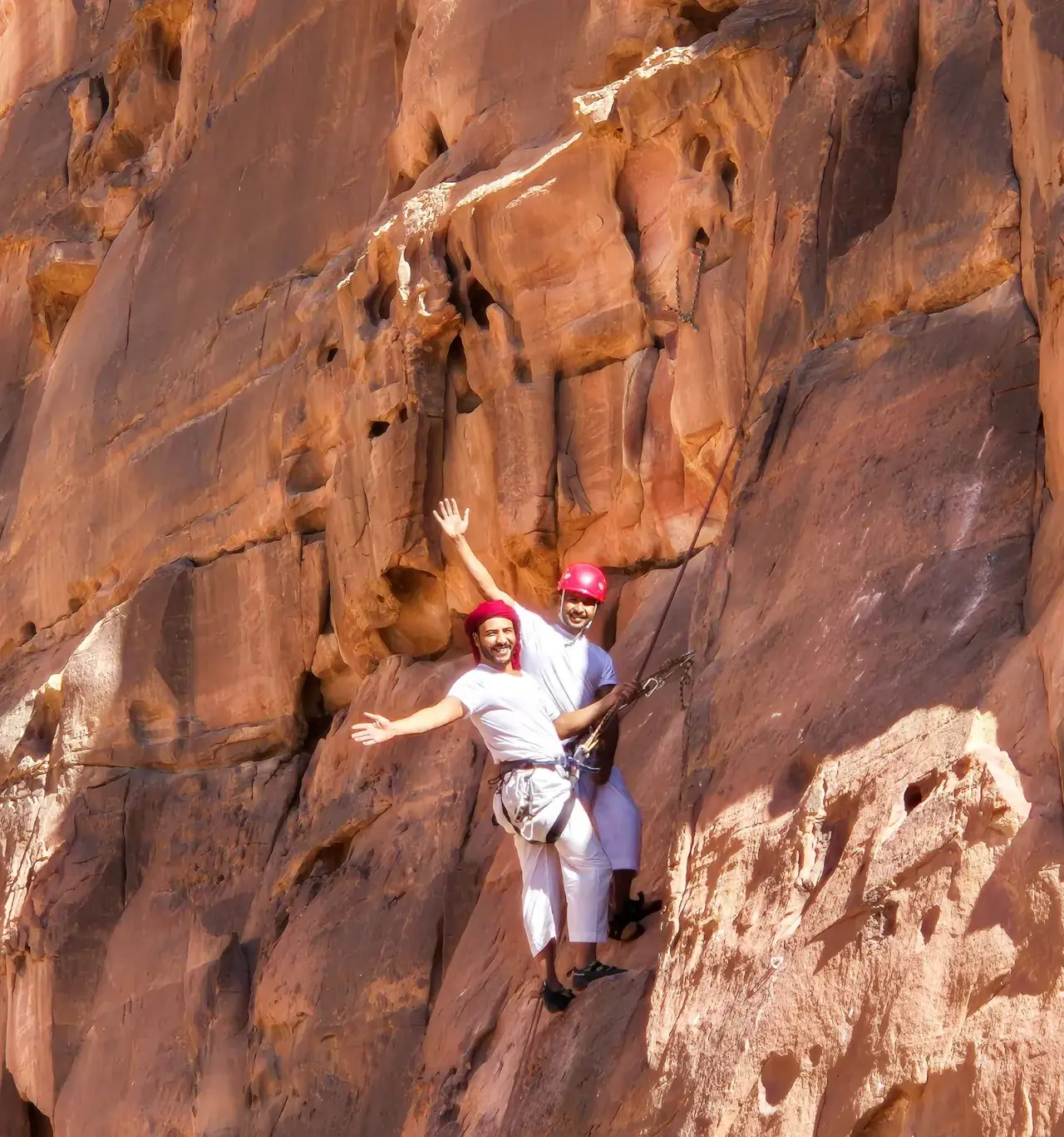
When to climb in Wadi Rum?
| Period | Day | Night | For climbing |
|---|---|---|---|
| December to February | 14 to 16 °C | 2 to 4 °C | Possible on fine days, in the sun. Short days (10 h), some rain. |
| March and April | 20 to 25 °C | 6 to 11 °C | The best time. Long days, dry rock, everything is climbable. |
| May | 30 °C | 14 °C | Good in the morning and in the shade. South faces heat up fast. |
| June to September | 32 to 34 °C | 16 to 18 °C | Too hot in the sun. Only at dawn or in the shade, short outings. |
| October and November | 21 to 27 °C | 8 to 13 °C | Excellent season, with beautiful light. |
Average temperatures in Wadi Rum (about 950 m above sea level). It is cooler and often windy on the summits: keep a warm layer in your pack, even in spring.
Sandstone, the user manual
Wadi Rum sandstone has great friction, but it is soft. Some holds sound hollow, especially in honeycomb features, and flakes can break. Test your holds, load them gradually and wear a helmet, even at the foot of the wall.
Wet sandstone loses its strength and holds snap. After rain, wait until it is fully dry, at least 24 hours and often longer in winter or in the shade. For the same reason, never climb in damp or sandy shoes: wipe them before every pitch.
Most routes are protected with cams and nuts. Original anchors are often slings around blocks or threads, baked by the sun: check them and back them up with your own cord. Sandstone wears ropes quickly: avoid running them over edges and take care on abseils.
Descents are part of the adventure. They often involve several abseils and long down-climbs on the domes, with few obvious cairns. Allow time, carry a headlamp and study the descent in the topo before you set off.
The main climbing areas
Jebel Rum
The giant above the village, over 1,700 m. Big routes on the east face, the Bedouin routes of Sheikh Hamdan and Hammad, and Lawrence’s Spring at its foot. Reached on foot from the village.
Umm Ishrin
The long wall facing Jebel Rum across the valley. Committing multi-pitch routes in a wild setting.
Nassrani and Um Ejil
Towers and domes south of the village, with classics such as The Beauty and bolted lines such as La Guerre Sainte.
Khazali
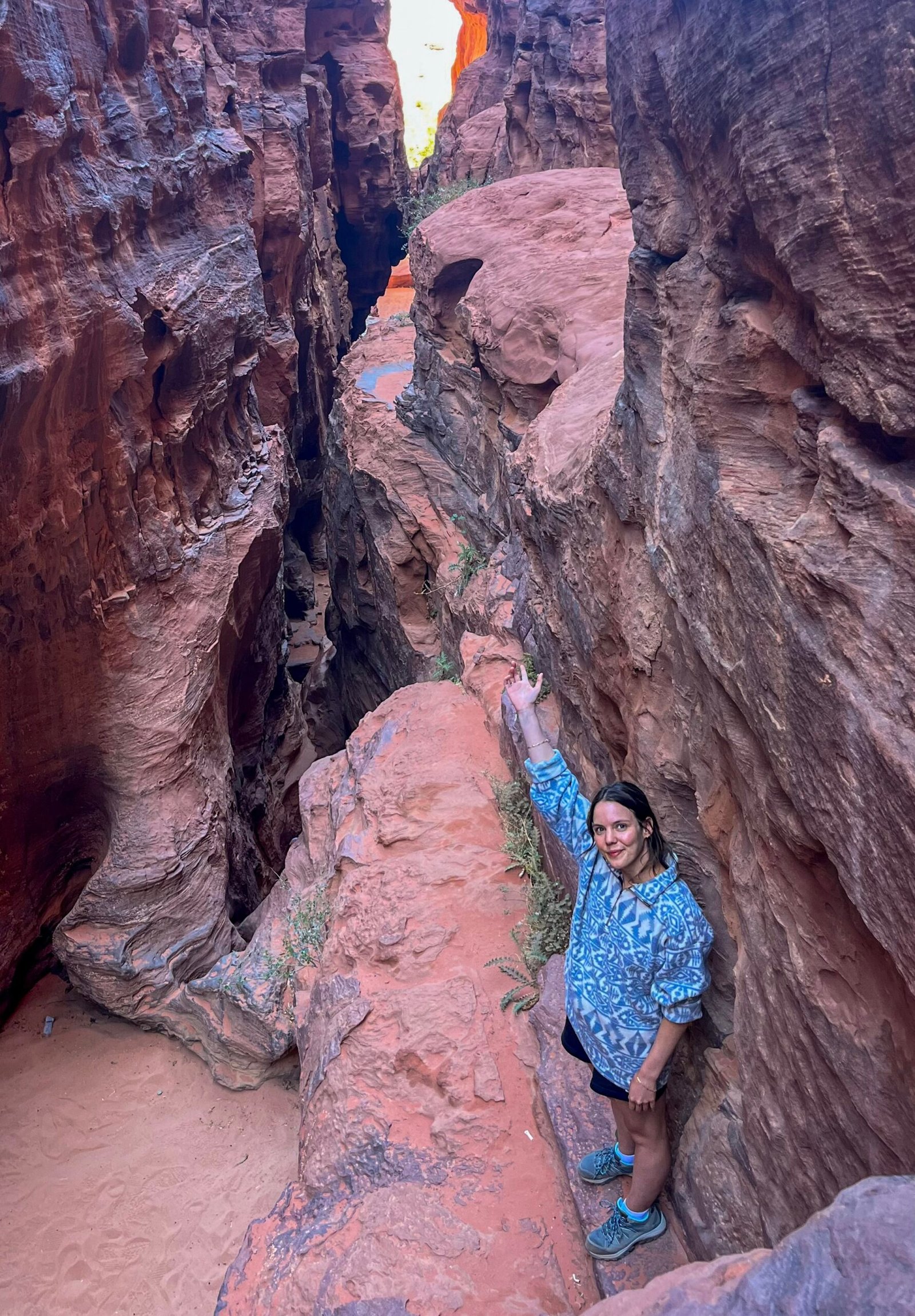
Famous for its narrow canyon with ancient inscriptions. Climbing and scrambling up the cracks.
Barrah Canyon
A long sandy corridor between two sandstone walls, with classics such as Merlin’s Wand and The Star of Abu Judaidah.
Burdah
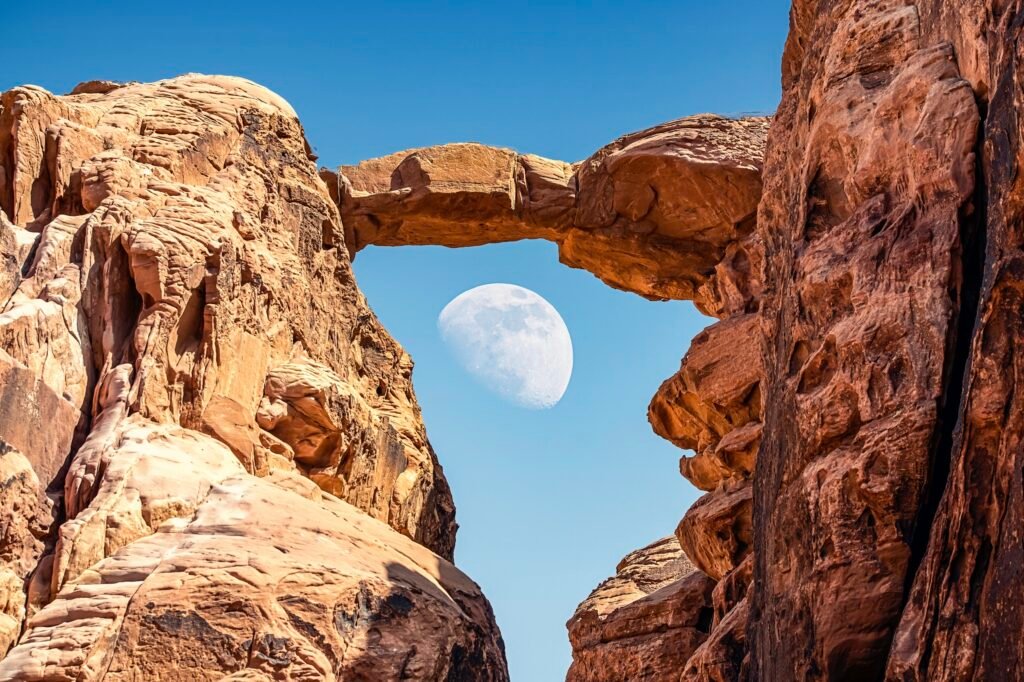
The most remote area, with its famous high rock bridge and Orange Sunshine, a fine mid-grade multi-pitch.
Umm ad Dami
Jordan’s highest point, 1,854 m, about 30 km south. A steep hike rather than a climb, with views into Saudi Arabia.
Apart from Jebel Rum, every area is reached by 4×4. Visitors are not allowed to drive alone in the protected area: a Bedouin guide takes you there.
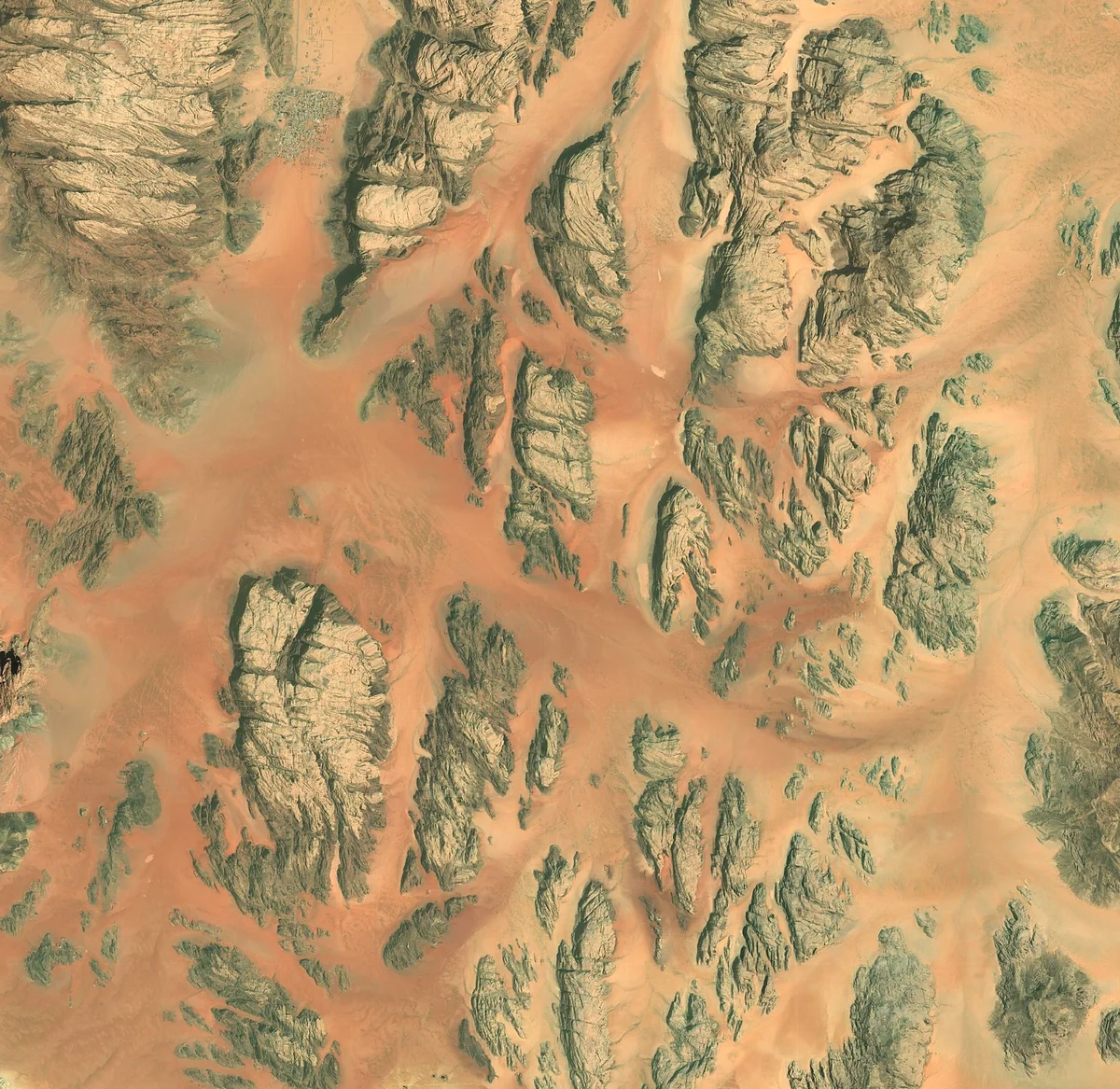
Imagery © Esri, Maxar, Earthstar Geographics. Area positions are indicative.
A few classic routes
| Route | Area | Grade | Height | Style |
|---|---|---|---|---|
| Crazy Camel | Jebel M’zeygeh | 6a+ to 6b+ | ≈ 100 m | Bolted, 4 pitches |
| Black Magic | Jebel Rum | 6a | ≈ 300 m | Trad |
| Pillar of Wisdom | Jebel Rum | 6a to 6b | ≈ 350 m | Trad |
| Lionheart | Jebel Rum | 6b | ≈ 350 m | Trad |
| The Beauty | Um Ejil · Nassrani | 6a to 6b | ≈ 200 m | Trad |
| La Guerre Sainte | Nassrani | 7b | 12 pitches | Bolted |
| Merlin’s Wand | Barrah Canyon | 6a+ | 5 pitches | Trad |
| The Star of Abu Judaidah | Barrah Canyon | 6b to 6c | ≈ 250 m | Trad |
| Orange Sunshine | Burdah | 5+ to 6a | ≈ 300 m | Trad |
French grades given as a guide: they vary between sources. Always check a recent topo before you go and ask a local guide.
The Bedouin routes
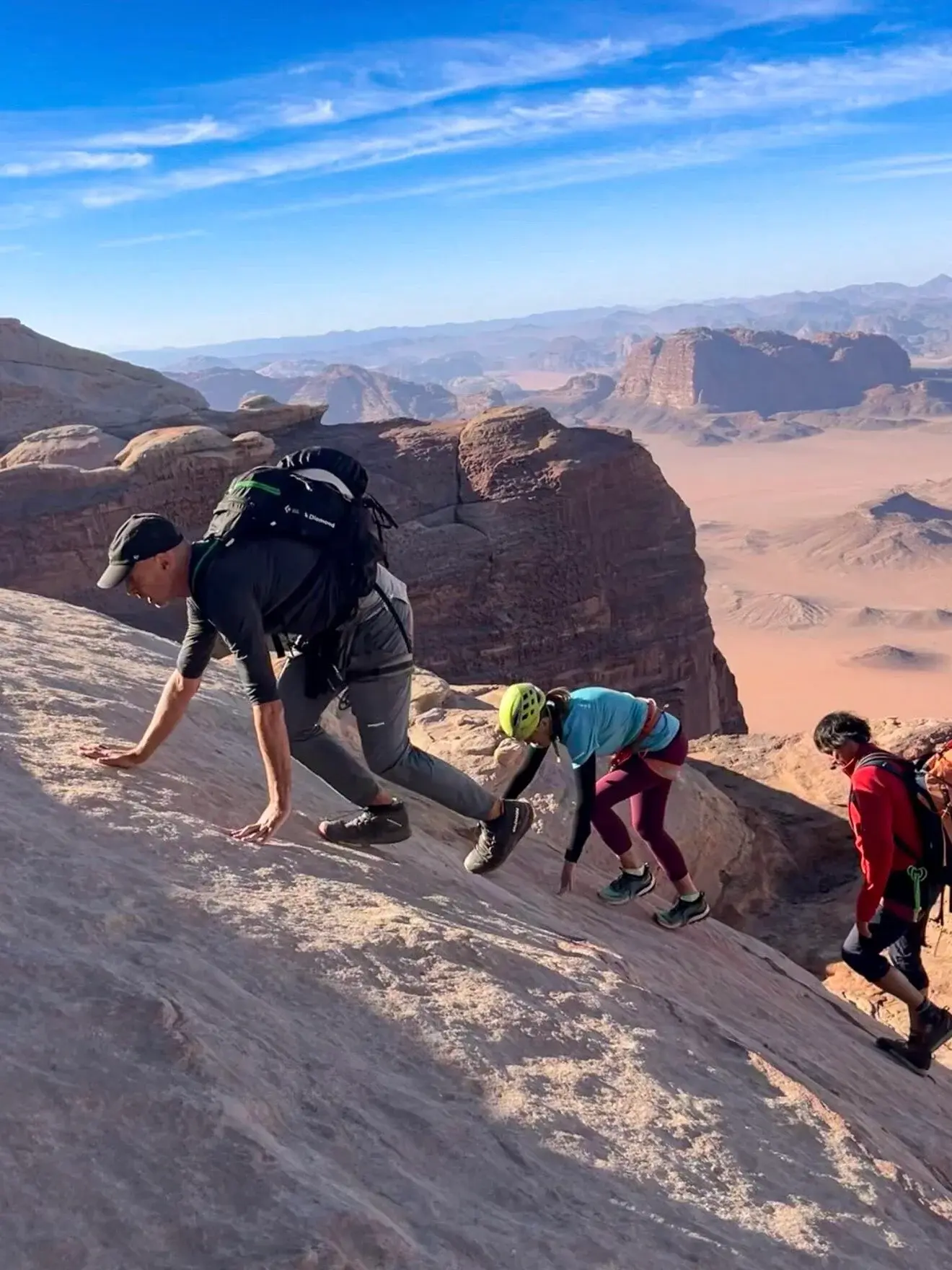
Bedouin routes follow the ways hunters used to reach the summits. They mix hiking, scrambling and a few climbing moves, and demand real route-finding skills. The best known climb Jebel Rum: Sheikh Hamdan’s Route and Hammad’s Route, often combined into a traverse, and the shorter Rijm Assaf.
Do not be fooled by their modest grades. The terrain is complex, the summits are mazes of domes where it is easy to get lost, and the descent takes as long as the ascent. Start early, take a rope for exposed moves and abseils, and carry water for the whole day.
If you do not know the way, go with a Bedouin guide: it is the safest way to do them, and a wonderful way to hear the story of these mountains.
What to bring
For a day out with us
- Climbing shoes if you have them (we can lend you some)
- Approach shoes with a good sole
- Layers, a windproof jacket, a warm hat for the evening
- Sun hat, sunglasses, sunscreen
- A 20 to 30 litre pack for water and lunch
- Helmet, harness, ropes and quickdraws: provided
If you climb on your own
- Two 60 m half ropes, plus a spare
- Double set of cams, from small to large sizes
- A full set of nuts
- Long slings, cord and maillons to back up anchors
- Helmet, headlamp, first aid kit
- 3 to 4 litres of water per person per day
- Offline map and a power bank
There is no climbing shop in Wadi Rum: bring everything. Your old ropes and shoes will make young climbers in the village very happy.
Safety and rescue
There is no official mountain rescue team in Wadi Rum. After an accident, the village’s Bedouin guides are usually first on the scene, with the tourist police, civil defence and, if needed, an army helicopter. It can take time: climb with a good safety margin.
Before you leave, give your route and expected return time to your camp or the Visitor Center, and check in when you are back. Phones work well around the village but often not deep in the canyons or behind the mountains.
Make sure your travel insurance covers climbing and helicopter evacuation. Carry a first aid kit, plenty of water and a warm layer, even for a short outing. In winter, never enter a canyon when storms are around: flash floods are sudden and dangerous.
Protected area rules
- Pay the entry fee at the Visitor Center (7 JOD, or the Jordan Pass) and keep your ticket.
- Visitors do not drive alone in the desert: travel with a Bedouin guide and stay on the tracks.
- No new bolts and no power drills: local ethics favour removable protection. Do not retro-bolt existing routes.
- Do not leave old slings or abandoned gear. If you back up an anchor, take the old material away.
- Use little chalk and brush off tick marks. Never mark the rock or build cairns.
- Do not disturb wildlife: Nubian ibex and Verreaux’s eagles live here. Some areas close to protect them.
- Camp and light fires only in camps. Take all your rubbish home.
- Respect the Bedouin: dress modestly in the village and ask before photographing someone.
Topos and resources
Tony Howard’s reference guidebook (Cicerone). Out of print but still the best source for the Bedouin routes.
Recent route pages with grades and climbers’ comments.
Useful for some big routes and their descents.
Thierry Souchard’s collection, with a selection of big routes in Wadi Rum.
The best living topo: he knows the state of the anchors, the descents and what is in condition.
The guide as a PDF
- 1Jebel Rum
- 2Umm Ishrin
- 3Nassrani · Um Ejil
- 4Khazali
- 5Barrah Canyon
- 6Burdah
Tap the book to flip through
Keep this guide on your phone: it works without signal, at the crag or at camp. A printable version with the map of the areas, the gear checklist and the emergency numbers.
Download the PDFLeave your email if you like: we write a few times a year at most (conditions, best periods, new trips). You can unsubscribe at any time.
Climb with Eid
Swipe to see all 6 trips →
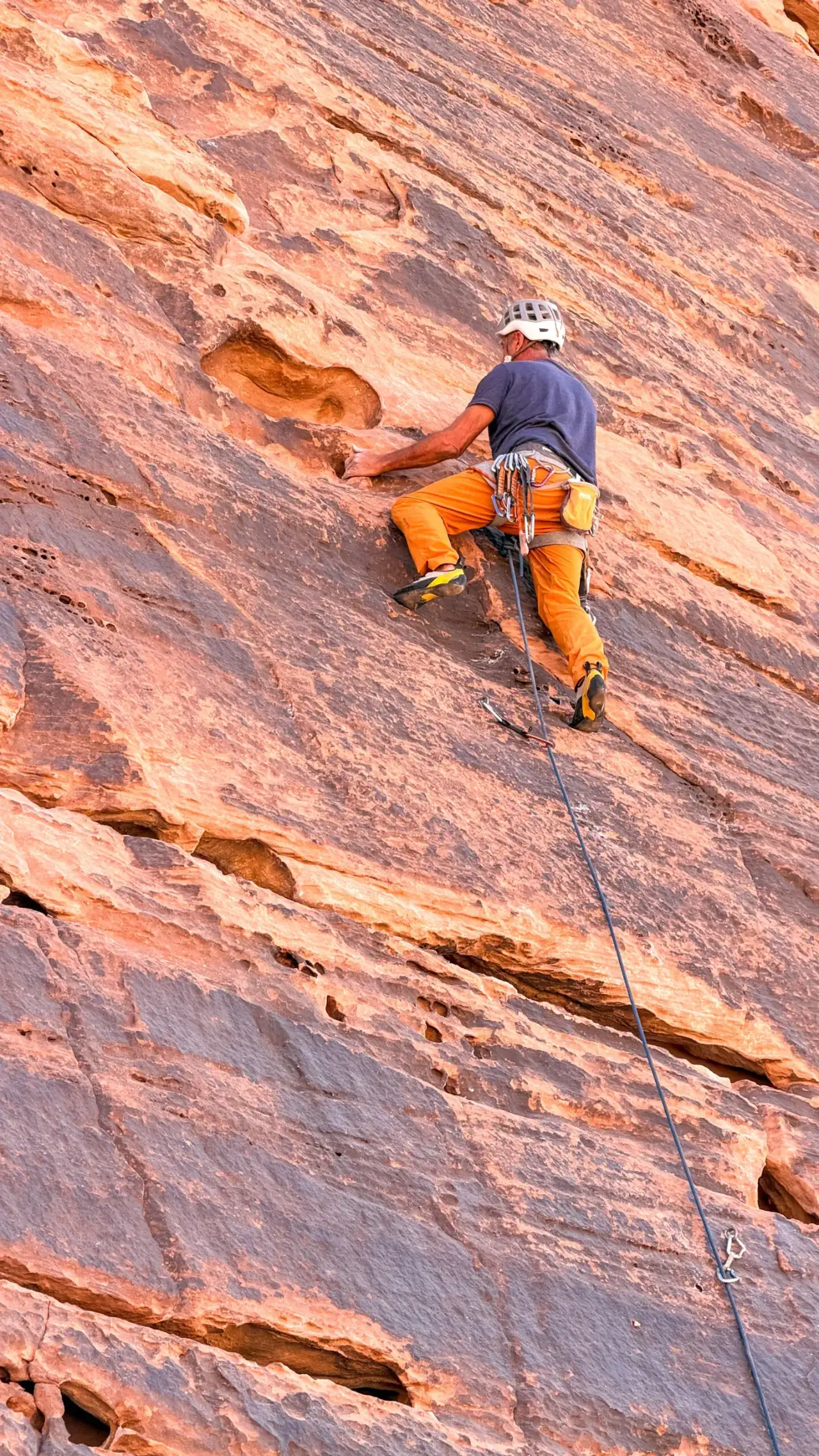
Climbing in Wadi Rum: frequently asked questions
Do I need to be an experienced climber to come to Wadi Rum?
Can I climb in Wadi Rum without a guide?
What is the best season for climbing?
How long should I wait after rain?
Are the routes bolted?
Can I rent gear on site?
What should I do in an emergency?
Let’s plan your desert journey together
Tell us your level, your dates and what you would love to do. Eid will suggest the climb that suits you.
Reply within 24 h · No deposit · Free cancellation up to 48 h before